
RIGOL DHO924S
4.5Editor score
250 MHz bandwidth
Built-in signal generator
50 Mpts memory depth
Digital oscilloscopes are essential tools for anyone working with electronics. They allow you to visualize voltage signals over time. Choosing the right one depends on your specific needs and budget constraints.
We evaluated ten leading models based on bandwidth, sampling rate, and features. Our analysis includes portable handheld units and advanced benchtop instruments for professional use.
Each pick highlights unique strengths like resolution or connectivity options. Prices can vary significantly so check current listings before making your final purchase decision today.
4.5Editor score
4.3Editor score

4.4Editor score
As an Amazon Associate we earn from qualifying purchases.
The following table provides a side-by-side comparison of all ten digital oscilloscope models to help you quickly identify the best fit for your application needs.


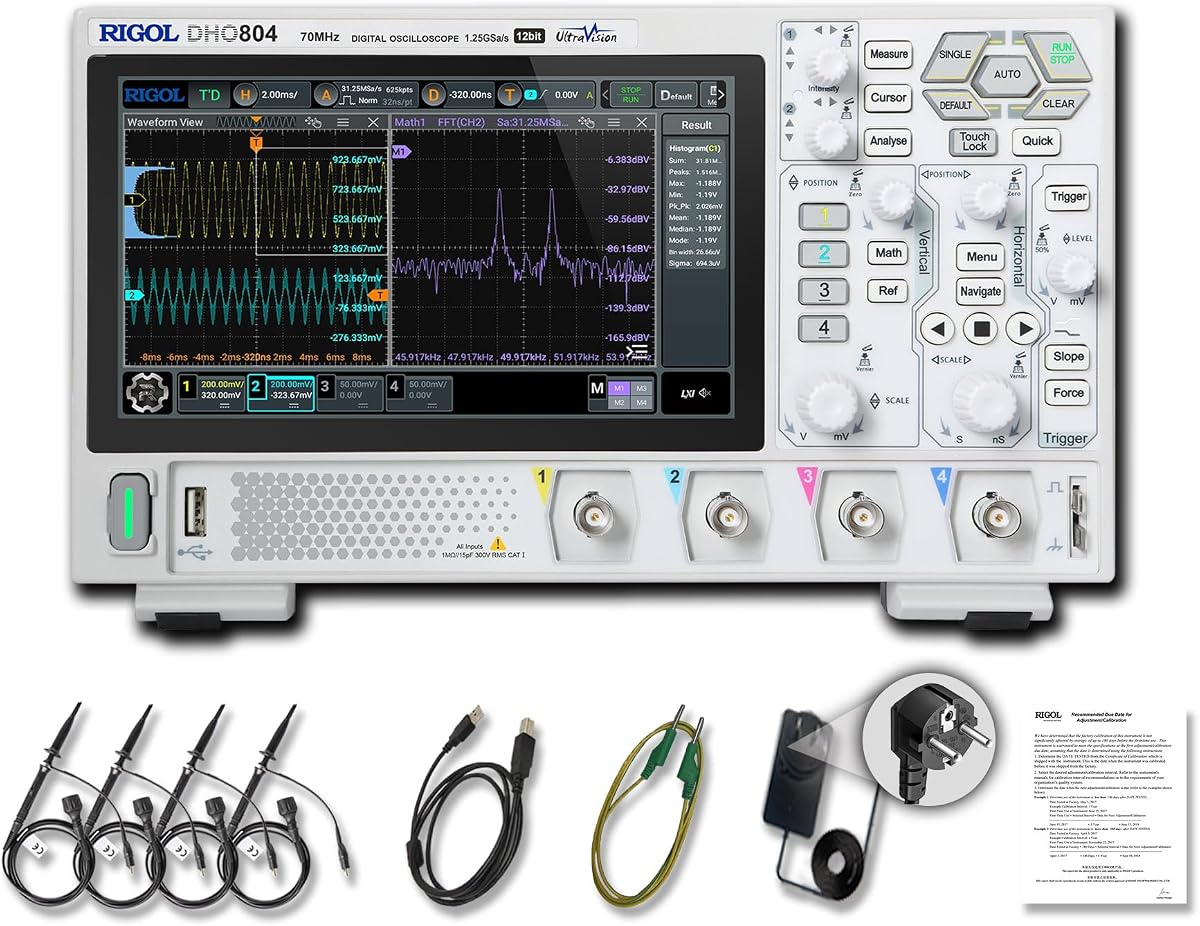
The RIGOL DHO804 stands out as a top choice for portable analysis due to its impressive 12-bit resolution. It captures fine vertical details that are often missed by standard 8-bit scopes. This makes it ideal for checking power ripple and noise in modern electronics.
We may earn a commission when you buy through this link, at no additional cost to you.
Its UltraAcquire technology provides up to one million waveforms per second helping you catch rare glitches quickly. The built-in search and navigation tools let you review long records efficiently. Standard serial trigger and decode support makes embedded debugging straightforward without extra hardware.
While the bandwidth is capped at 70 MHz it is sufficient for many mixed signal tasks. The 25 Mpts memory depth allows for long captures without compromising sample rate. Users may find the price higher than entry-level models but the performance justifies the investment for serious work.
Engineers who need to correlate multiple rails or troubleshoot embedded systems will appreciate this device. The flexible knobs and touch screen streamline daily measurements. We recommend this model for those prioritizing signal fidelity over maximum bandwidth.
The 12-bit vertical resolution offers significantly better signal detail than standard scopes.
Event and time navigation accelerates finding intermittent glitches in complex signals.
We may earn a commission when you buy through this link, at no additional cost to you.
The RIGOL DHO924S offers the premium features for demanding engineering tasks with its 250 MHz bandwidth. It retains the 12-bit resolution of the DHO804 allowing for precise measurements at higher frequencies. The included signal generator and Bode plot analysis add significant value for loop testing.
We may earn a commission when you buy through this link, at no additional cost to you.
Users benefit from 50 Mpts memory depth which supports long records at full sample rate. The S model includes single-channel AFG output for testing frequency response directly. Intensity grading and navigation tools remain top notch for visualizing rare signal anomalies effectively.
This model is more expensive than its lower bandwidth counterparts but it offers robust automation capabilities. Web control and SCPI support facilitate remote operation in lab environments. The main trade-off is the need for a separate probe to unlock the sixteen digital channels.
It is an excellent choice for power supply validation and high-speed embedded timing work. The touch display and flex knob improve productivity during complex debugging sessions. We suggest this unit for professionals requiring advanced analysis features in a portable form.
The Bode plot capability simplifies loop stability tests for power engineers.
Web control and SCPI enable seamless integration into automated test workflows.
We may earn a commission when you buy through this link, at no additional cost to you.
The FNIRSI DPOS350P brings a 350 MHz bandwidth to the handheld market at an accessible price point. It combines an oscilloscope with a spectrum analyzer and frequency response analyzer in one device. This versatility makes it a strong contender for field work and general electronics repair.
We may earn a commission when you buy through this link, at no additional cost to you.
Its FFT capabilities allow for real-time spectral analysis from 200 kHz to 350 MHz. The built-in signal generator outputs waveforms up to 50 MHz with adjustable offsets and duty cycles. Users can store thousands of waveforms and screenshots for documentation and later review.
While the bandwidth is impressive the resolution adjusts between 8 and 16 bits depending on settings. This dynamic behavior can be confusing for beginners expecting consistent vertical performance. The device requires some learning to utilize its multiple modes effectively compared to simpler scopes.
This unit is ideal for hobbyists who need wide bandwidth and multiple tools in one case. The 8000 mAh battery ensures long runtimes during extended field sessions. We recommend it for those prioritizing frequency range and multi-functionality over pure resolution depth.
Combines scope, spectrum analyzer, and signal gen to reduce bench clutter significantly.
Large battery capacity supports hours of continuous operation away from mains power.
We may earn a commission when you buy through this link, at no additional cost to you.
The RIGOL DS1102Z-E has a reputation for reliability and ease of use in educational settings. It features a 100 MHz bandwidth and 1 GSa/s sample rate suitable for most student projects. The high customer rating reflects its durability and straightforward interface for learning basics.
We may earn a commission when you buy through this link, at no additional cost to you.
Standard deep memory up to 24 Mpts allows for long captures without losing sample rate. Hardware waveform recording supports event review playback which is excellent for teaching signal analysis. Serial bus decoding for common protocols helps students debug embedded systems efficiently.
Two channels limit simultaneous measurements compared to four channel models. The design is compact and robust but lacks modern touch screen interfaces. Some users might prefer newer features but the core performance remains competitive for the price point.
This is the go-to choice for university labs and electronics training courses. The connectivity options like LAN and USB support documentation workflows easily. We recommend it for students and hobbyists needing a dependable benchtop instrument.
Built-in waveform recording lets you replay events to analyze transient signals later.
Native decoding for UART and I2C simplifies embedded electronics training tasks.
We may earn a commission when you buy through this link, at no additional cost to you.
The FNIRSI 2C53T is an upgraded portable unit that combines a scope with a multimeter and signal generator. It offers 50 MHz bandwidth and a 4.5 digit meter for comprehensive diagnostics. This combination is perfect for field technicians who need multiple instruments in one hand.
We may earn a commission when you buy through this link, at no additional cost to you.
The FPGA and MCU architecture provides stable performance and fast measurement responses. It can store reference waveforms and compare them directly with measured signals on screen. The high voltage protection module adds safety for measuring up to 400 volts continuously.
The bandwidth is modest which may limit high speed digital work. The display is smaller at 2.8 inches making it harder to view complex traces. Users upgrading from basic tools will appreciate the added functionality despite these size trade-offs.
This device is well suited for maintenance work and quick troubleshooting tasks. Battery life is strong with standby times up to six hours. We suggest it for professionals needing a compact solution for general electronic verification.
A built-in 4.5 digit multimeter allows for simultaneous voltage and resistance checks.
Reference waveform features help identify deviations quickly during repair work.
We may earn a commission when you buy through this link, at no additional cost to you.
The FNIRSI DSO152 is arguably the most affordable option for entry-level users needing signal visualization. It features 200 kHz bandwidth and a 2.5 MS/s sample rate which covers basic audio and low frequency work. Its pocket size makes it easy to carry in a toolbox.
We may earn a commission when you buy through this link, at no additional cost to you.
The auto setup function simplifies operation allowing beginners to see waveforms quickly. One-key calibration helps maintain baseline accuracy without complex menus. Firmware upgrades via Type-C keep the device current with new features and improvements over time.
Bandwidth is limited to audio frequencies and low speed digital signals. It is not suitable for modern microcontroller debugging or power supply ripple analysis. Users should view this as a basic tool rather than a full replacement for benchtop scopes.
It is a great starting point for hobbyists on a strict budget or students in early courses. The battery lasts about four hours and it charges via standard Type-C. We recommend it for occasional use where portability and cost matter most.
An accessible price point lowers the barrier for beginners learning about signals.
Lightweight construction makes it easy to transport to various job sites.
We may earn a commission when you buy through this link, at no additional cost to you.
The Hantek DSO2D15 offers 150 MHz bandwidth in a compact economy package. It is designed for commissioning and education in aerospace and embedded systems. The standard triggers and protocol decodes make it useful for various research and communication tasks.
We may earn a commission when you buy through this link, at no additional cost to you.
Its arbitrary waveform output allows for signal generation without extra equipment. The sixteen trigger modes provide flexibility for capturing specific signal events. This model balances cost and features well for small labs needing moderate performance capabilities.
The interface is straightforward but lacks advanced graphical enhancements found in higher end models. Build quality is acceptable but may not withstand heavy industrial use over long periods. Users seeking basic performance at a low cost will find it adequate.
This unit is a strong candidate for schools or startups needing multiple units. Its light weight makes it easy to distribute among different workstations. We suggest it for general lab use where advanced analysis is not the primary requirement.
Fourteen trigger modes ensure you can capture rare events reliably in circuits.
Ideal for equipping multiple workstations without breaking department budgets.
We may earn a commission when you buy through this link, at no additional cost to you.
The FNIRSI 1013D Plus features a 7 inch touch display for intuitive control and easy operation. It offers 100 MHz bandwidth and a 1 GSa/s sample rate suitable for general debugging. The capacitive screen allows for gesture based measurements and fast navigation.
We may earn a commission when you buy through this link, at no additional cost to you.
A waveform manager stores up to 1000 screenshots allowing for organized project documentation. The Lissajous display helps compare amplitude and phase between two signals effectively. Battery life is supported by a 6000 mAh internal unit for portable field work.
Touchscreen responsiveness may vary depending on glove usage or environmental conditions. The menu structure can be complex requiring time to learn all available functions. However the visual feedback is excellent for visualizing signal parameters clearly.
This model is suitable for field technicians needing a graphical interface for quick adjustments. The high voltage tolerance makes it safe for mains measurements with appropriate probes. We recommend it for users who prefer touch interaction over physical knobs.
Touch gestures allow for direct on-screen amplitude and frequency readings.
Built-in storage manages screenshots to keep project logs organized easily.
We may earn a commission when you buy through this link, at no additional cost to you.
The listing for this model does not provide detailed information at this time. Product titles and images are currently unavailable in the source data. We recommend checking the manufacturer or retailer directly for updated details on this unit.
We may earn a commission when you buy through this link, at no additional cost to you.
Without specific details we cannot evaluate its performance or suitability for your needs. It is possible this model has been discontinued or replaced by a newer version. Please verify current availability before attempting to purchase this item online.
If you are looking for alternatives please consider the models ranked above this entry. They provide reliable performance and documented features for digital signal analysis. Always check compatibility with your specific application requirements.
We apologize for the lack of information regarding this specific item. Future updates may provide more clarity on its capabilities and benefits. For now it is best to proceed with one of the verified options available.
Please verify product details with the seller before making a purchase decision.
We may earn a commission when you buy through this link, at no additional cost to you.
Information for this final model is currently missing from the product database. Title and image assets are not available for display in this guide. We suggest researching similar models from established brands for reliable results.
We may earn a commission when you buy through this link, at no additional cost to you.
Lacking specifications prevents us from offering a meaningful review or comparison. It is possible this item is out of stock or pending a new release cycle. Always confirm current status before attempting to place an order.
The top nine entries in this guide offer proven performance and features. They cover a wide range of bandwidths and price points for various needs. We encourage you to explore those options for your specific application.
We aim to provide accurate data for all listed products but some listings may change. Please refer to the manufacturer for the most up to date information available. We apologize for any inconvenience caused by missing details.
Confirm current stock status with the vendor before attempting to purchase.
We may earn a commission when you buy through this link, at no additional cost to you.
Selecting the right digital oscilloscope requires understanding key technical specifications that align with your measurement needs.
Bandwidth defines the highest frequency signal you can accurately measure. Ensure the scope bandwidth is at least three to five times higher than your signal frequency. Sampling rate should exceed four to five times the bandwidth to avoid aliasing effects.
Always match bandwidth and sampling rate to your fastest signal requirements to prevent distortion.
Memory depth determines how long a signal record you can capture at maximum sample rate. Larger memory is essential for capturing long duration events or rare glitches. Look for scopes with deep memory to maintain resolution over time.
Choose deep memory to capture detailed events without losing fidelity in long records.
Most scopes offer eight bit resolution but newer models provide twelve bit options. Higher vertical resolution reveals small signal details and noise floor improvements. Consider 12 bit models for power supply analysis and sensitive measurements.
Higher bit depth improves detail visibility for low noise and ripple measurements.
Two channel scopes are sufficient for simple circuits while four channels support complex systems. Consider if you need to monitor multiple rails or differential pairs simultaneously. Some models allow combining channels for advanced math operations.
Four channels offer greater flexibility for multi-signal debugging and complex circuit analysis.
A clear display with high contrast helps visualize signals in bright environments. Touchscreens can improve navigation speed but physical knobs allow precise adjustments. Choose a balance that suits your workflow preferences.
Select a display and controls that match your speed and precision needs.
USB, LAN, and HDMI ports enable easy data export and remote control. Built-in storage for screenshots and waveforms simplifies documentation. Ensure the scope supports standard protocols like SCPI for automation.
Connectivity options are vital for integrating your scope into lab automation systems.
Handheld scopes offer convenience for field work but may sacrifice advanced features. Check battery life to ensure it lasts through your typical usage duration. Consider weight and size for daily transport needs.
Battery life and weight are critical factors for portable and field-based measurements.
Features like serial decoding and FFT analysis add value for embedded work. Built-in signal generators can reduce bench clutter and extra costs. Evaluate if these features justify the price increase for your use case.
Optional tools like decoders and generators can streamline complex debugging tasks.
Always start by calibrating the probes using the front panel signal generator. Adjust the compensation screw until the square wave appears flat and clean. This ensures accurate amplitude and frequency readings for your measurements.
Use appropriate probe settings such as 10x to minimize circuit loading effects. Connect the ground clip to a common ground point before applying voltage to avoid shorts. Always verify probe attenuation settings in the scope menu.
Store the oscilloscope in a dry environment free from extreme temperatures and humidity. Clean the screen with a soft microfiber cloth and avoid harsh chemicals. Proper care extends the lifespan of your instrument significantly.
For modern digital circuits like microcontrollers and FPGA signals aim for at least 100 MHz. If you work with higher speed interfaces like DDR memory you may need 200 MHz or more. Always check the rise time of your signals to determine accurate bandwidth needs.
Memory depth is critical for capturing long duration events without lowering sample rate. A scope with shallow memory will reduce sample rate when capturing long records leading to aliasing. Look for 10 Mpts or more for professional debugging tasks.
Handheld scopes are excellent for field work and simple troubleshooting but lack advanced features. Benchtop models offer better screens and more channels for complex analysis. Choose a handheld if portability is your top priority.
12-bit resolution provides 256 times more vertical levels than standard 8-bit scopes. This allows you to see smaller voltage changes and noise details. It is particularly useful for power supply ripple and low voltage analog signals.
Many modern scopes include built-in arbitrary waveform generators which save space. If you need advanced modulation or complex waveforms check if the scope supports them. A separate generator may be needed for specialized applications.
Most scopes include USB Host/Device or LAN ports for connection. You can use vendor software to view waveforms or control settings remotely. Some models support SCPI commands for custom automation scripts.
Use 10x probes for higher voltage signals to prevent loading the circuit. For high frequencies ensure the probe bandwidth matches your scope. Active probes are better for very fast signals due to lower capacitance.
Auto set adjusts vertical and horizontal scales to center and scale the waveform quickly. It is helpful for beginners or when exploring unknown signals. For fine tuning you will still need to adjust parameters manually.
We have reviewed ten models ranging from budget handhelds to advanced benchtop instruments. The RIGOL DHO804 and DHO924S lead in resolution and features while the FNIRSI DSO152 offers affordability.
Prioritize bandwidth and memory depth based on your specific signal requirements. For embedded work choose a model with serial decoding and long memory. For portable work focus on battery life and size.
Prices and availability change frequently so check current listings before buying. Ensure you have the right accessories like probes and software. With the right tools you can analyze any signal effectively.