
BUFFALO LinkStation 210
3.9Editor score
1-Bay with HDD included
Simple centralized storage backup
24/7 US support
This expert guide compares the top 10 low power consumption NAS devices for home and office, evaluating efficiency features performance and value for users.
Network attached storage devices are essential for centralizing data, but energy efficiency matters for 24-7 operation. Low power consumption NAS units reduce electricity bills and heat output while maintaining reliability.
We compared ten top models focusing on processor efficiency, active and idle power usage, and real-world performance. Our analysis includes entry-level to advanced units with varying drive bays and networking options.
Each pick highlights key specs, pros, cons, and ideal use cases. Prices and availability change frequently, so verify current details before purchasing. This guide helps you choose the most efficient solution for your needs.
3.9Editor score

4.5Editor score

4.2Editor score
This side-by-side comparison evaluates all ten selected low power consumption NAS models. We analyze core specifications, connectivity options, and target use cases to help you identify the most efficient device for your storage requirements.




The UGREEN NAS DXP2800 is a highly capable low power consumption NAS designed for advanced home users and creators. It holds a 4.5 rating and stands out for its Intel N100 CPU, which balances performance and efficiency well.
We may earn a commission when you buy through this link, at no additional cost to you.
This device handles 4K media and heavy workloads effortlessly. It supports Docker, virtual machines, and AI photo management. The 2.5GbE networking ensures fast transfers without excessive energy draw during operation.
While powerful, it requires you to purchase HDDs and SSDs separately. Setup may demand some technical knowledge for advanced features. These trade-offs are acceptable for users seeking a robust, efficient central hub.
Buy this if you need a versatile, energy-efficient NAS for media, backups, and smart home tasks. It delivers exceptional value for creators and tech enthusiasts needing reliable local storage without constant energy costs.
The Intel N100 Quad-Core CPU provides excellent performance per watt, ensuring low idle and active power consumption while handling demanding tasks like video transcoding and Docker containers.
Built-in AI tools recognize people, objects, and scenes in photos, automatically organizing albums and detecting duplicates to save storage space and simplify media management for large libraries.
We may earn a commission when you buy through this link, at no additional cost to you.
The UGREEN NAS DH2300 is designed for beginners and personal users seeking a private, low power consumption NAS. With a 4.5 rating, it offers intuitive storage and backups without recurring cloud fees.
We may earn a commission when you buy through this link, at no additional cost to you.
This model supports massive capacity up to 64TB and features AI photo tagging to organize memories. It ensures privacy with layered security and automated backups across all your devices seamlessly.
It lacks Docker support and Wi-Fi connectivity, limiting advanced use cases. Transfer speeds are capped at 125MB/s. These constraints are acceptable for users prioritizing simplicity and cost savings over power.
Choose this for personal photo storage, backups, and avoiding monthly subscriptions. It is ideal for those transitioning from cloud storage who want a reliable, energy-efficient solution without complex configurations.
Unlike cloud subscriptions, this NAS requires only a one-time purchase, saving thousands over ten years while providing full ownership of your data and eliminating recurring monthly fees.
End-to-end encryption, RAID modes, and two-factor authentication protect your data locally. TRUSTe and TÜV SÜD certifications ensure compliance with strict international security standards.
We may earn a commission when you buy through this link, at no additional cost to you.
The MINISFORUM N5 Air is a powerhouse low power consumption NAS for professionals needing extreme performance. Rated 4.2, it features an AMD Ryzen 7 255 CPU and supports up to 174TB of storage.
We may earn a commission when you buy through this link, at no additional cost to you.
This unit includes 10GbE and 5GbE ports for ultra-fast transfers. It supports PCIe expansion, OCuLink, and 8K video outputs. Its robust build allows for demanding workloads like virtualization and AI tasks.
While efficient at idle, full-load power usage is higher. Setup requires technical knowledge. These trade-offs are necessary for users needing maximum throughput and expandability in a compact form factor.
Buy this for professional media editing, large-scale data centers, or advanced virtualization. It delivers unparalleled performance and capacity, making it ideal for power users prioritizing efficiency and future-proofing.
With five SATA bays and three M.2 slots, this NAS supports up to 174TB total. RAID configurations ensure data security while providing immense space for large video libraries and backups.
Dual LAN ports, USB4, PCIe x16, and OCuLink enable flexible expansion. Connect GPUs, network cards, or external drives to enhance performance and adapt the NAS to evolving technical needs.
We may earn a commission when you buy through this link, at no additional cost to you.
The Synology DS225+ is a premium low power consumption NAS ideal for media streaming and private cloud storage. With a 4.6 rating, it offers robust hardware transcoding and intuitive software for seamless access.
We may earn a commission when you buy through this link, at no additional cost to you.
This model supports 30 IP cameras for smart home surveillance. It features fast 282 MB/s transfer speeds and reliable multi-layered data protection. Synology's OS ensures stability and regular security updates.
It comes diskless, requiring separate drive purchases. Expansion is limited compared to higher-bay models. These are minor drawbacks for users prioritizing reliability and media performance over massive scalability.
Choose this for reliable streaming and home security. It is perfect for users seeking a polished, efficient ecosystem with minimal setup time and long-term hardware support backed by a strong warranty.
Hardware transcoding enables smooth 4K streaming to any device without buffering. This reduces CPU load and power consumption while delivering high-quality playback across multiple platforms simultaneously.
Multi-layered protection combines RAID, snapshots, and automated backups. Integrated surveillance tools with AI detection ensure your home and data remain secure against loss, theft, or unauthorized access.
We may earn a commission when you buy through this link, at no additional cost to you.
The BUFFALO LinkStation 210 is the best budget low power consumption NAS for basic home storage. With a 3.9 rating, it provides a ready-to-use solution including a 2TB HDD and simple centralized management.
We may earn a commission when you buy through this link, at no additional cost to you.
This device offers secure closed-system protection to minimize vulnerabilities. It supports RAID for data redundancy and automated backups for connected devices. 24/7 US-based support ensures assistance whenever needed.
It lacks advanced app support and modern high-speed networking. Performance is adequate for light tasks. These limitations are acceptable for users needing affordable, secure storage without technical complexity.
Buy this for simple, affordable home backup. It is ideal for households needing a hassle-free, low-power solution for shared files and media without the cost or complexity of advanced NAS systems.
The included 2TB drive and plug-and-play design reduce initial setup costs and time. This makes it an accessible entry point for users seeking basic network storage without extra hardware purchases.
Unlike open systems, this device uses a closed architecture to prevent unauthorized app vulnerabilities. SSL encryption and built-in security tools ensure data remains safe during local transfers and remote access.
We may earn a commission when you buy through this link, at no additional cost to you.
The UGREEN NAS DXP4800 GT is a high-performance low power consumption NAS for creators and teams. With a 4.5 rating, it features dual 10GbE ports and AMD Ryzen Embedded processors for smooth multitasking.
We may earn a commission when you buy through this link, at no additional cost to you.
This model supports Docker, VMs, and extensive app ecosystems. Surveillance tools allow local recording without cloud subscriptions. USB and SD slots simplify quick transfers for creators on the go.
It defaults to non-ECC RAM, though upgrades are supported. Power usage is higher than entry models. These trade-offs are acceptable for teams requiring fast collaborative workflows and robust feature sets.
Choose this for office collaboration and heavy media editing. It delivers enterprise-grade speed and flexibility at a consumer price, making it ideal for tech-savvy users needing efficient, scalable local storage.
Dual 10GbE ports enable up to 2.5GB/s theoretical throughput. This ensures rapid large file transfers and smooth multi-user access, reducing wait times during collaborative creative workflows.
Surveillance Center supports ONVIF cameras with multi-view and event detection. Local storage eliminates recurring cloud fees while ensuring footage remains private and accessible only to authorized users.
We may earn a commission when you buy through this link, at no additional cost to you.
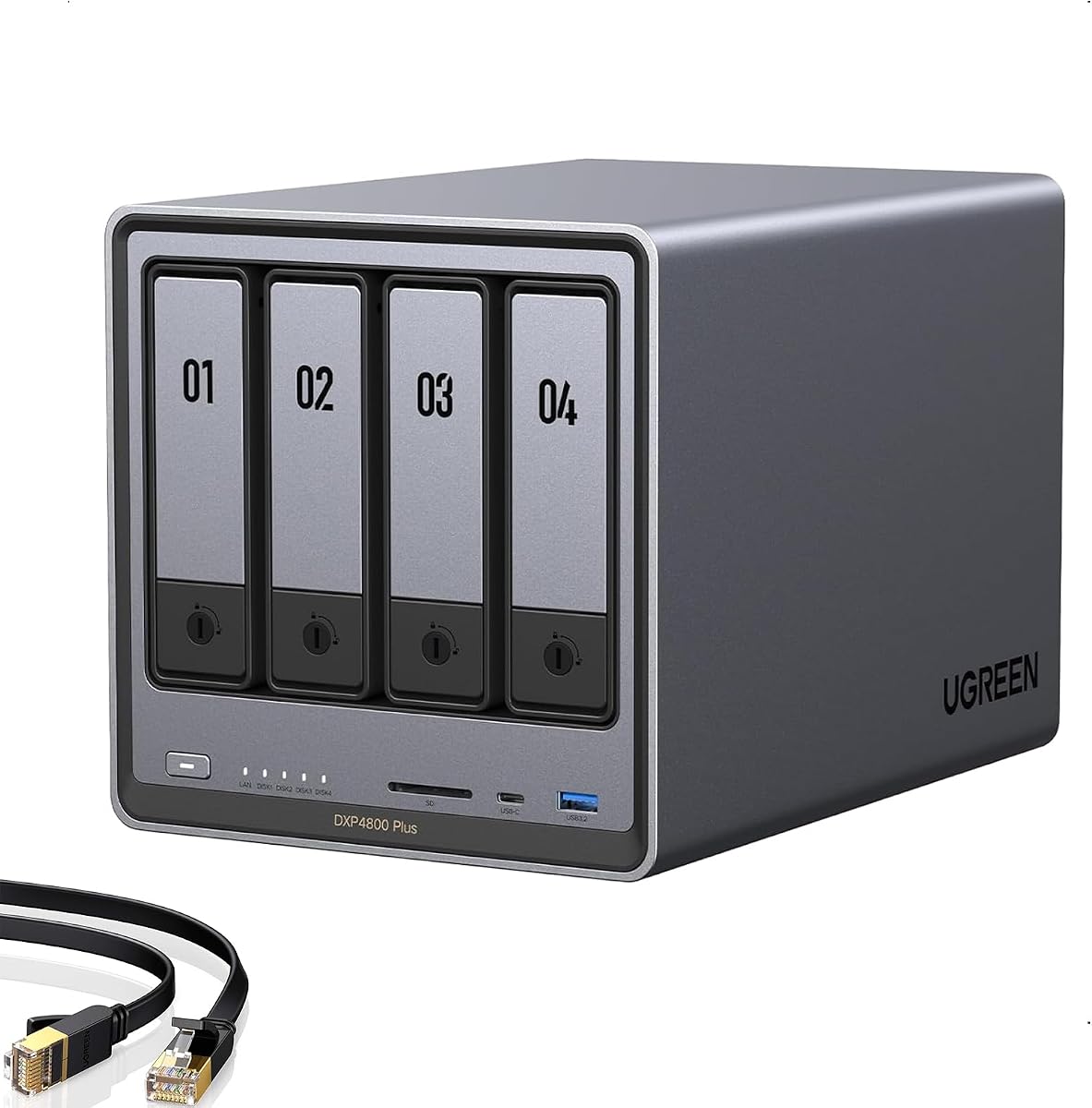
The UGREEN DXP4800 Plus is a versatile low power consumption NAS for families and small teams. Rated 4.5, it offers high-performance processing and AI tools to organize photos and secure private cloud storage.
We may earn a commission when you buy through this link, at no additional cost to you.
This device supports 10GbE transfers for instant backups and media access. Permission management protects privacy during collaboration. Its compatibility with third-party drives ensures flexible and affordable storage expansion.
It requires HDDs to be purchased separately. Wi-Fi is unavailable, necessitating wired connections. These are minor considerations for users prioritizing speed, security, and reliable local storage for family use.
Buy this for shared family media and secure backups. It is ideal for users needing a reliable, efficient system that balances performance with ease of use for diverse household storage needs.
AI automatically organizes photos by faces and scenes, removing duplicates to save space. This simplifies media management for large family libraries, ensuring easy access and efficient storage use.
Flexible permission management allows controlled access for multiple users. Encryption and local ownership protect sensitive files, ensuring secure collaboration without relying on third-party cloud services.
We may earn a commission when you buy through this link, at no additional cost to you.
The Synology DS223j is an entry-level low power consumption NAS offering reliability and simplicity. With a 4.5 rating, it provides a secure private cloud for file sharing and backups across all devices.
We may earn a commission when you buy through this link, at no additional cost to you.
This model features automated backups and home security recording. Synology's mature OS ensures stability and frequent updates. 2-year warranty and expert support add confidence for users seeking dependable local storage.
Hardware limitations restrict heavy multitasking or high-speed transfers. Drives must be purchased separately. These are acceptable for casual users prioritizing ease of use and brand reliability over performance.
Choose this for basic home backups and file sharing. It is perfect for users wanting a no-fuss, energy-efficient solution backed by Synology's proven ecosystem and continuous software improvements.
Multi-platform access allows seamless file sharing and syncing across devices. Colleagues and family stay on the same page with secure, remote access to important documents and media anytime.
Set-and-forget backups protect Macs, PCs, and mobile devices. Multiple destinations including cloud and external drives ensure data recovery options against loss, corruption, or accidental deletion.
We may earn a commission when you buy through this link, at no additional cost to you.
The Beelink ME Mini N150 is an ultra-compact low power consumption NAS ideal for quiet environments. With a 4.4 rating, it features Intel N150 processors and six M.2 slots for fast, expandable storage.
We may earn a commission when you buy through this link, at no additional cost to you.
This unit supports various NAS OS options and runs silently under 35dB. Dual 2.5G ports enable fast transfers. Its vertical cooling maintains optimal temperatures for stable 24/7 operation in any room.
It lacks traditional HDD bays, relying on SSDs for capacity. Setup requires technical knowledge. These trade-offs suit users prioritizing space-saving and energy efficiency over massive traditional hard drive storage.
Buy this for quiet, efficient office or bedroom use. It is perfect for tech enthusiasts needing a small, low-power device for Plex, backups, or light virtualization without noise or heat.
Intel N150 processor and vertical airflow cooling ensure minimal power draw and noise. This makes it ideal for continuous 24/7 operation without impacting energy bills or disrupting quiet environments.
Six M.2 slots support up to 24TB total. Compatible with various SSD sizes, this allows custom configurations balancing speed and capacity for efficient data handling and quick access times.
We may earn a commission when you buy through this link, at no additional cost to you.
The Beelink ME Mini PC is a versatile low power consumption NAS suitable for home theater, office, and networking. With a 4.6 rating, it features an Intel N95 processor and dual 2.5G LAN ports.
We may earn a commission when you buy through this link, at no additional cost to you.
This device supports 4K video playback and fast internet connectivity. Lifetime technical support ensures long-term reliability. Pre-installed OS simplifies setup for home office work or centralized storage tasks.
It relies on internal SSDs for storage. Drive expansion is limited compared to dedicated NAS units. These constraints are acceptable for users seeking a compact, multi-use system over high-capacity hard drive storage.
Buy this for multi-purpose home and office setups. It is ideal for users needing a small, efficient device combining NAS storage, media playback, and daily computing without excessive power consumption.
This compact device serves as NAS, media center, and office PC. Pre-installed Windows 11 and flexible connectivity allow diverse use cases, reducing the need for multiple separate hardware devices.
Intel N95 and 12GB RAM deliver smooth multitasking with low energy use. Dual 2.5G ports ensure reliable network performance for fast file transfers and stable streaming without excessive power draw.
We may earn a commission when you buy through this link, at no additional cost to you.
Selecting a low power consumption NAS requires balancing energy efficiency, performance, and storage needs. Consider these factors to find a device that minimizes electricity costs while meeting your daily requirements.
Look for processors designed for low power use, such as Intel N-series or AMD Embedded chips. These provide adequate performance for most tasks while keeping idle and active power consumption minimal.
Efficient processors reduce heat output and electricity bills, ensuring your NAS runs silently and economically 24/7 without sacrificing essential speed.
Determine how much storage you need now versus future expansion. Consider bays for HDDs or SSDs and total supported capacity to avoid costly upgrades later.
Balancing capacity with efficiency prevents over-provisioning, which wastes energy. Choose a model with flexible expansion to adapt to your growing data needs.
Evaluate network ports like Ethernet speed and availability of Wi-Fi adapters. Dual LAN ports and 2.5GbE support improve performance but may slightly increase power draw.
Select connectivity matching your home or office network setup to ensure fast, stable access without unnecessary hardware or energy overhead.
Assess the NAS operating system for ease of use, update frequency, and app support. Mature systems offer better optimization for power management.
User-friendly software simplifies configuration and security settings, helping you maintain efficient operation with minimal manual intervention or energy-intensive workarounds.
Consider cooling design and fan noise levels, especially for home offices or bedrooms. Effective passive or low-speed cooling reduces power usage and improves acoustic comfort.
Quiet operation ensures your NAS fits seamlessly into living spaces without disruption while maintaining safe operating temperatures for hardware longevity.
Check for encryption, two-factor authentication, and backup automation. Robust security prevents unauthorized access that could waste resources or compromise data.
Investing in built-in security reduces reliance on external, energy-heavy solutions and ensures your NAS remains a secure, efficient central hub for all data.
Look for generous warranty periods and responsive technical support. Quality support minimizes downtime and ensures efficient troubleshooting without requiring replacements.
Reliable warranty protection guarantees your investment lasts, reducing long-term waste and providing peace of mind for energy-efficient, continuous operation.
Verify supported drive types and sizes, including SSD vs HDD. Some units support only specific drives, which affects performance and overall power profile.
Choosing compatible, energy-efficient drives further reduces total system consumption, ensuring the NAS operates optimally for your specific storage and performance needs.
Begin by securely installing compatible hard drives and connecting the NAS to your router. Use wired Ethernet for maximum stability. Follow the on-screen setup wizard to configure users and permissions.
Regularly update firmware and system software to maintain efficiency and security. Schedule automated backups and enable power-saving settings for idle times. Monitor temperature to ensure proper ventilation and prevent overheating.
Perform periodic checks on drive health and RAID integrity. Use manufacturer tools to run diagnostics and replace failing drives promptly. Clean dust from vents to sustain optimal airflow and minimize fan power usage.
A low power consumption NAS is a network-attached storage device designed to use minimal electricity while maintaining reliable performance. These devices often feature energy-efficient processors and smart power management for continuous 24/7 operation without excessive energy costs.
Most low power NAS models use between 10 to 30 watts during active operation and less than 10 watts in idle or sleep modes. Actual consumption depends on processor type, connected drives, and current workload demands.
Yes, many low power NAS devices support Docker containers, virtual machines, AI photo management, and surveillance tools. Efficient processors like the Intel N100 balance performance and energy use to handle these features effectively.
Most low power NAS units operate quietly due to efficient cooling systems and fewer high-speed components. Some models include silent fan designs or passive cooling, making them suitable for home offices or living rooms.
Yes, most low power NAS models allow drive upgrades by replacing existing HDDs or SSDs with higher-capacity versions. Always check compatibility guidelines for supported sizes, interfaces, and RAID configurations before purchasing.
No, low power NAS units store data locally, eliminating the need for cloud subscriptions. They offer secure private cloud access with optional remote services, but all core storage and management remain on your own hardware.
The UGREEN NAS DXP2800, BUFFALO LinkStation 210, and MINISFORUM N5 Air lead as top picks for efficiency, budget, and performance respectively. Each offers unique features tailored to different storage needs and technical expertise.
Prioritize processor efficiency, storage capacity, and connectivity options to ensure your NAS meets your workload without unnecessary energy waste. Security, support, and expandability also play vital roles in long-term satisfaction.
Prices and availability fluctuate regularly. Always verify current specs and deals before purchasing to secure the best value and performance for your home or office low power storage setup.