
YCA1030 Dusk to Dawn Sensor
4.4Editor score
Hard-wired photocell design
IP65 weatherproof rating
Fits standard outlet boxes
Compare the top light sensors for home security to secure your property with smart automation and reliable detection systems.
Modern homes require intelligent security solutions that adapt to their environment. Light sensors for home security play a crucial role in automating lighting and detecting intruders efficiently.
This guide compares ten real products ranging from wireless Zigbee detectors to hard-wired photocells. We evaluate connectivity, range, battery life, and smart home compatibility to help you choose.
Each pick includes detailed specs, pros, and cons based on manufacturer data. Prices and availability change frequently so verify details before purchasing your next smart home component.
4.4Editor score


4.4Editor score
This side-by-side comparison highlights key specifications across all ten products. Use it to quickly identify connectivity types, detection ranges, and power requirements for your specific security needs.


The Zigbee Motion Sensor with Light Sensor is a top choice for advanced home automation enthusiasts. It stands out by combining a PIR motion detector with a real-time ambient light sensor. This combination allows for sophisticated local automations that depend on both movement and room lighting conditions.
We may earn a commission when you buy through this link, at no additional cost to you.
Its integration with Home Assistant and SmartThings makes it ideal for users who want control without cloud reliance. The sensor detects motion up to 26 feet away and offers three adjustable sensitivity levels. This flexibility helps reduce false triggers from pets or heat sources while maintaining reliability.
One trade-off is the requirement for a Zigbee hub. It will not connect directly to Wi-Fi or Alexa. If your setup already includes a compatible hub, this is a minor constraint. The CR2450 battery ensures over a year of typical use and low battery alerts keep you informed.
This sensor is best for tech-savvy homeowners seeking precise lighting control. Whether you want lights to turn on only when it is dark and motion is detected this device delivers. Its compact design and adjustable mounting base make it easy to place in entryways or hallways.
Build automations that react to motion and light levels without cloud services for faster response and better privacy.
Reduce unnecessary lighting by ensuring lights only activate when the room is dark and movement is detected.
We may earn a commission when you buy through this link, at no additional cost to you.
The YCA1030 is a classic photocell sensor for homeowners who want simple automatic outdoor lighting. It replaces old squiggly wire sensors with modern electronics. The UL listing ensures safety for both commercial and residential fixtures making it a trustworthy choice for basic needs.
We may earn a commission when you buy through this link, at no additional cost to you.
It operates on standard 120V to 277V power and fits most residential outlet boxes. The IP65 rating protects it against rain and dust. A built-in time delay prevents lights from turning off when headlights pass by ensuring consistent operation.
The main limitation is the need for hard-wiring. This is not a plug-and-play smart device. It also lacks remote control or app integration. However for many users this simplicity is a benefit as it reduces dependency on networks or batteries.
This sensor is perfect for porch lights or garage floodlights that need to turn on at dusk. If you want reliable hands-free operation without app complexity this model delivers. It is a cost-effective way to secure your exterior with automatic lighting.
Automate outdoor lights effortlessly with a trusted photocell that turns lights on at dusk and off at dawn.
Built to withstand rain and dust with an IP65 rated housing designed for outdoor post lamp poles.
We may earn a commission when you buy through this link, at no additional cost to you.
The Philips Hue Outdoor Motion Sensor offers seamless integration for users already invested in the Hue ecosystem. It is designed specifically for outdoor use with a weatherproof build. The sensor combines motion detection with light sensing to automate lighting efficiently.
We may earn a commission when you buy through this link, at no additional cost to you.
It covers a wide 160-degree area which is ideal for driveways or front porches. The automatic dusk to dawn feature ensures lights only activate when needed saving energy. It works with Alexa Google Assistant and Apple HomeKit through the Bridge.
Installation is straightforward with the ability to mount on flat walls or corners. Battery power means no electrical wiring is needed. However the reliance on the Hue Bridge is a prerequisite. If you do not own one the initial cost increases significantly.
This sensor is the best choice for Hue users wanting a reliable outdoor security solution. It provides peace of mind with secure connections and flexible control. Whether you want to deter intruders or welcome guests this sensor delivers consistent performance.
Unlock full smart home features and stable connections when you pair this sensor with the Hue Bridge.
Specially designed for outdoor environments with an IP44 rating to ensure performance in various weather.
We may earn a commission when you buy through this link, at no additional cost to you.
The Ring Motion Detector is a straightforward option for home security focused on alerts. It connects over Amazon Sidewalk for flexible coverage without needing a dedicated base station. The sensor covers a 90-degree angle making it suitable for rooms and hallways.
We may earn a commission when you buy through this link, at no additional cost to you.
Its pet-friendly mode helps reduce false alarms from smaller animals. You can customize settings to ignore pets under 50 pounds. Alerts are sent instantly to your mobile device so you can respond quickly to potential intruders.
While it offers solid functionality it relies on Amazon Sidewalk for connectivity. This may limit placement options depending on your home's layout. It is more focused on alerts than complex lighting automation. If you prioritize security alerts this is a strong contender.
This detector is best for homeowners wanting reliable intruder alerts with minimal setup. It works well for monitoring high-traffic areas like entryways. The lack of a base station requirement makes it accessible for users who want simple security enhancements.
Uses Amazon Sidewalk to provide coverage throughout your home and beyond without a separate base station.
Customize settings to ignore movement from pets under 50 lbs to reduce unnecessary notifications.
We may earn a commission when you buy through this link, at no additional cost to you.
The Akamatis Litos v3 is a specialized sensor for advanced smart home users. It uses mmWave radar to detect both motion and stationary presence. This capability allows for more accurate automation than standard PIR sensors that fail to detect stillness.
We may earn a commission when you buy through this link, at no additional cost to you.
It includes a precise ambient light sensor that matches human eye sensitivity. This ensures lights turn on only when someone is present and the room is dark. The light-permeable front design allows for accurate measurements without physical obstruction.
Setup requires familiarity with Home Assistant. The ESPHome firmware simplifies configuration but still demands technical knowledge. If you are willing to invest time in setup the benefits are significant. The Wi-Fi connection provides direct integration without a hub.
This sensor is ideal for those seeking high precision in automated lighting. It solves common issues with traditional motion detectors that ignore stationary users. For a smart home powered by open-source principles this is a standout choice for detection and lighting control.
Detects both motion and stationary objects indoors for more accurate automation than standard PIR detectors.
The integrated light sensor matches human vision to ensure accurate ambient light readings for automation.
We may earn a commission when you buy through this link, at no additional cost to you.
The TP-Link Tapo Motion Sensor offers a balance of performance and efficiency. It uses a Sub-1G Low-Power Wireless protocol which extends battery life and improves range compared to standard Wi-Fi devices. This makes it reliable for long-term use.
We may earn a commission when you buy through this link, at no additional cost to you.
It covers a wide 120-degree angle and detects motion up to 23 feet away. The adjustable body and sensitivity settings allow you to tailor detection to your space. You can set custom time frames for real-time notifications in the Tapo App.
Smart Actions let you control lights and other devices based on motion events. This is useful for automating lighting without relying on cloud services. The included adhesive or magnetic mounting options simplify installation. However the hub requirement is a necessary investment.
This sensor is perfect for homes using the Tapo ecosystem. It provides reliable coverage and efficient energy use. If you want a dependable sensor that lasts two years on a single battery this model delivers excellent value for money.
Operate for up to two years on a single battery thanks to the efficient Sub-1G Low-Power Wireless protocol.
Control Tapo smart devices like lights with motion triggers even when the network is disconnected.
We may earn a commission when you buy through this link, at no additional cost to you.
This 2-pack of Dusk to Dawn sensors provides excellent value for homes needing multiple automatic controls. Each unit handles a wide voltage range and is UL Listed for safety. The IP65 water-resistant rating ensures they can withstand outdoor weather elements.
We may earn a commission when you buy through this link, at no additional cost to you.
The delay feature prevents accidental triggering from passing car headlights. This ensures your lights stay on consistently even with nearby traffic. The swivel mount allows precise aiming for optimal light direction. Installation requires disconnecting power and threading the switch into the knockout hole.
Since these are hard-wired they are best for users comfortable with basic electrical work. They do not offer smart control but deliver reliability. Having two units in one purchase simplifies replacing old sensors or setting up multiple lights at once.
This pack is ideal for driveway and porch lights needing simple automation. It is a practical solution for securing multiple areas without complex wiring or apps. The three-year warranty adds confidence to this straightforward outdoor lighting product.
Get two reliable outdoor sensors in one package to save money when automating multiple exterior light points.
Each sensor is UL Listed to ensure it meets safety standards for commercial and residential fixtures.
We may earn a commission when you buy through this link, at no additional cost to you.
The YoLink Indoor Motion Sensor is designed for large properties with unique connectivity needs. It uses LoRa wireless technology to achieve a range of over 2,000 feet. This makes it superior to Wi-Fi for spanning multiple floors or buildings.
We may earn a commission when you buy through this link, at no additional cost to you.
Security is a priority since it does not connect to your home Wi-Fi. This reduces vulnerability to hacking. Setup is easy with the Plug & Play method. You can receive SMS or email notifications when motion is detected.
You can pair sensors directly to sirens without internet. This device-to-device pairing ensures alarms sound even if the internet is down. The sensor mounts easily on metal surfaces using the built-in magnet. It is a robust choice for extensive security coverage.
This sensor is best for large homes or small businesses needing broad coverage. If you want a secure system that does not strain your Wi-Fi this option excels. The ability to operate offline adds a layer of reliability for critical security tasks.
Cover multiple floors and buildings with a 2,034-foot range thanks to advanced LoRa wireless technology.
Avoid exposing your home Wi-Fi to risks by connecting only to the secure YoLink Hub.
We may earn a commission when you buy through this link, at no additional cost to you.
The Philips Hue Secure Contact Sensor is a specialized tool for monitoring indoor doors and windows. While it detects contact rather than ambient light it automates lighting based on entry points. When armed it sends real-time alerts to your mobile device.
We may earn a commission when you buy through this link, at no additional cost to you.
Placement is simple with the included adhesive backing. You can place it on doors windows or cabinets. If you want to mimic presence when away you can automate lights to turn on when doors open. It provides peace of mind for home security.
It relies on the Hue Bridge for full functionality. The app lets you arm and disarm the system and view activity logs. This integration ensures that your lighting responds to security events seamlessly. It is an efficient way to extend Hue features.
This sensor is best for securing entry points and automating lights accordingly. If you have a Hue setup you can enhance security with this compact device. It complements motion sensors by focusing on specific access points in your home.
Monitor doors and windows to receive instant alerts and trigger lights when unauthorized entry is detected.
Use automation to turn on lights when doors open making it appear someone is home to deter intruders.
We may earn a commission when you buy through this link, at no additional cost to you.
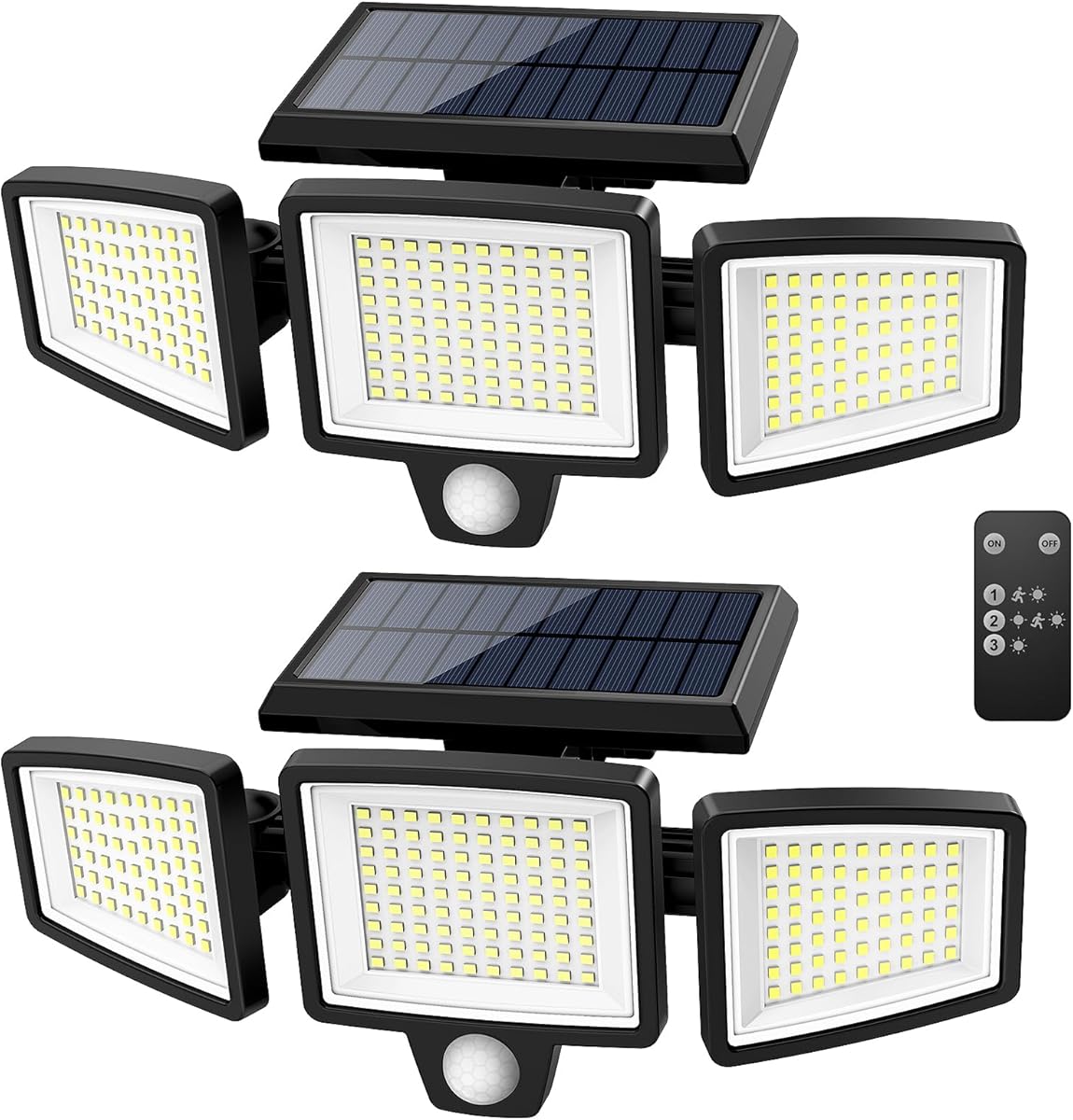
The Tuffenough Solar Outdoor Lights combine illumination and motion detection in one package. This makes them a convenient solution for areas needing both security and visibility. The 210 LEDs produce up to 2500 lumens providing strong light.
We may earn a commission when you buy through this link, at no additional cost to you.
They include three adjustable heads and a wide 270-degree angle to cover large areas. The remote control allows you to select three modes for brightness flexibility. Solar power means no wiring is needed just install and let the panel charge.
Performance depends on adequate sunlight. You should position the panel facing direct sun for best results. In heavy rain or winter the battery life may reduce. The IP65 rating protects against heavy rain and snowstorms for reliable outdoor use.
This option is best for outdoor spots needing independent lighting without wiring. It is practical for driveways garages or gardens. If you want an all-in-one light sensor kit this provides great value and ease of installation for home security.
Save on wiring costs with a solar powered design that charges during the day and runs at night.
Cover a large area with a 270-degree wide angle and adjustable heads for precise light direction.
We may earn a commission when you buy through this link, at no additional cost to you.
Choosing the right light sensor depends on your home layout and connectivity preferences. Use this guide to understand key factors and make an informed decision.
Connectivity is a primary factor. Sensors may use Wi-Fi Zigbee or LoRa. Wi-Fi offers direct connection but can strain networks. Zigbee and LoRa offer better range and battery life with a hub.
If you want smart features choose Wi-Fi or Zigbee. If you want range select LoRa. Ensure your hub or router supports the protocol.
Sensors are either battery powered or hard-wired. Battery powered units are easier to install but need replacements. Hard-wired ones provide constant power but require electrical work.
Choose hard-wired for continuous use without maintenance. Choose battery for flexibility and easy placement.
Detection range varies by product. PIR sensors typically cover 20 to 25 feet while mmWave can reach up to 20 feet indoors. Consider the space you need to monitor.
Select a sensor with range that covers the area completely. Avoid placing sensors where furniture or objects block detection paths.
Ensure the sensor works with your existing system. Some require hubs while others connect directly to Alexa or Google. Verify compatibility before purchase to avoid integration issues.
If you use Home Assistant choose Zigbee or LoRa. If you use Philips Hue choose a Hue compatible model.
For outdoor use weather resistance is essential. Look for IP ratings like IP44 or IP65. These ensure the sensor can handle rain and dust.
Choose IP65 for heavy weather areas. IP44 is sufficient for covered porches or protected spots.
Adjustable sensors allow you to aim detection precisely. Look for 360-degree mounts or swivel options. This helps avoid false triggers from moving objects.
Choose sensors with adjustable mounts for hallways and entryways. Fixed sensors are fine for general room coverage.
Alerts can be push notifications SMS or app-based. Some sensors also trigger sirens. Choose based on how you want to be notified.
Select sensors with app alerts for real-time updates. For severe alerts choose those with siren integration.
Consider how easy it is to install. Some need drilling or wiring. Others use adhesive or magnetic mounts. Check the installation steps before buying.
Choose plug-and-play for quick setup. Choose wired for permanent security without battery changes.
To use a light sensor place it where motion and light changes are common. Avoid areas with frequent heat or moving shadows. Aim the sensor away from direct sunlight for accurate light detection.
Connect the sensor to your hub or app following the setup guide. Test detection by walking through the area. Adjust sensitivity if it triggers falsely. Ensure the battery is fresh for reliable alerts.
Care involves checking battery levels regularly and cleaning the lens with a soft cloth. Protect outdoor units from snow or excessive dust. Keep firmware updated to maintain performance and compatibility.
Many light sensors work in total darkness as they detect motion rather than light. However if the sensor is a dusk to dawn type it may require ambient light to trigger. Check specific product details to confirm operation in dark.
Some require a hub while others connect directly to Wi-Fi. Zigbee sensors need a hub for communication. Wi-Fi sensors do not need one. Check the product specs to confirm connectivity requirements before purchasing.
Some models integrate with Google Home while others need a bridge. Philips Hue sensors work via Bridge. Zigbee models work via ZHA. Ensure compatibility with Google Home by checking the supported platforms list.
Most wireless sensors use CR2450 or CR123A batteries. Always check the product description for the exact battery type. Rechargeable models are less common. Ensure you have spare batteries for maintenance.
Motion sensors typically detect up to 20 to 25 feet indoors. Outdoor sensors may reach up to 30 feet. Range depends on the technology used. PIR models differ from mmWave models in detection capabilities.
Many sensors have pet-friendly modes to avoid false alerts. You can adjust sensitivity or ignore small movements. Check for specific pet-friendly settings before purchase. This reduces false alarms from small household animals.
Yes light sensors can trigger lights and alarms for security. They are often paired with cameras or sirens. They help deter intruders. Check if the model supports security alerts or automation triggers.
Ensure your hub or router is close to the sensor. Check battery levels and firmware updates. Reset the sensor and try reconnecting. If problems persist review your network settings or contact support.
We covered ten top options ranging from Zigbee detectors to solar lights. Each offers unique features for different needs. The Zigbee Sensor leads for smart homes while the YCA1030 offers budget reliability.
Prioritize connectivity and power sources to fit your setup. If you want remote control choose Wi-Fi. If you want longevity choose LoRa. Consider your ecosystem compatibility before buying.
Prices and availability change so verify current details before purchasing. This guide helps you select the right model for secure automation. Check prices and read product descriptions for the latest updates.