
SVBONY SV503 102mm ED
4.8Editor score
102mm F7 Aperture
S-FPL51 ED Glass
Dual-Speed Focuser
Discover the top apochromatic refractors for astronomy. This guide compares ten leading models for clarity, portability, and astrophotography performance.
Apochromatic refractors are the gold standard for clear, color-free views. They use special glass to eliminate the color fringing common in basic telescopes. This makes them ideal for both visual observing and capturing sharp deep sky images.
We compared ten top models based on optics quality, build, and value. Our list covers compact travel scopes and larger imaging tubes. Each entry highlights key features to help you find the right match for your needs.
Every pick shows real specs and strengths drawn from manufacturer data. Prices and availability change often so check links for the latest details. Read on to find the perfect apochromatic refractor for your astronomy journey.
4.8Editor score

4.5Editor score

This side-by-side comparison lists all ten selected models with their core specifications and direct links. Use this table to quickly check aperture size focal ratio and included accessories before you decide.




The SVBONY SV550 80mm APO is a top-rated telescope offering exceptional optical clarity for the price. It earns our Editor's Choice badge for its balanced performance in visual and imaging tasks.
We may earn a commission when you buy through this link, at no additional cost to you.
Its triplet apochromatic optics use FPL51 ED glass to virtually eliminate color fringing. The air-spaced design ensures bright views of nebulae and star clusters with sharp detail.
While it lacks a mount, the magnesium alloy focuser reduces weight significantly. Extinction barriers inside the barrel prevent stray light from degrading image contrast during long exposures.
This scope is ideal for intermediate astronomers wanting premium optics without premium costs. Buy it for its reliable performance and robust optical design suited for serious hobbyists.
The triplet design uses low-dispersion glass to fix blue-edge aberration common in simpler refractors.
Lightweight magnesium components make this OTA easy to transport to dark sky sites.
We may earn a commission when you buy through this link, at no additional cost to you.
This Explore Scientific ED80 offers brilliant views thanks to genuine FCD1 HOYA ED glass. It is perfect for stargazing sessions and astrophotography of the Moon and deep sky objects.
We may earn a commission when you buy through this link, at no additional cost to you.
The air-spaced triplet design minimizes chromatic aberration effectively. Its compact size allows it to be mounted on larger scopes for guiding purposes while remaining portable.
Collimation adjustments help maintain tight star shapes. Being based in the USA ensures reliable customer service if issues arise with the telescope.
Choose this model if you value brand support and optical quality. It is a solid choice for both visual observers and beginners in photography.
FCD1 HOYA glass delivers excellent clarity and reduced color fringing for all targets.
With a retractable dew shield and 480mm focal length, it is easy to transport.
We may earn a commission when you buy through this link, at no additional cost to you.
This SVBONY SV550 bundle includes a field flattener to ensure sharp stars across the entire frame. It is designed specifically for deep sky astrophotography with full-frame cameras.
We may earn a commission when you buy through this link, at no additional cost to you.
The telescope uses a triplet apochromatic lens to maintain color accuracy. Its 180mm dovetail plate provides a stable base for mounting accessories securely.
While the cost is higher than a bare OTA, the included flattener saves money on separate purchases. The magnesium focuser keeps the setup light for travel.
Opt for this kit if you want a ready-to-go imaging solution. It simplifies the setup process for capturing crisp nebula images.
The SV209 flattener corrects curvature to ensure sharp stars at the image edges.
A hollow 180mm dovetail plate offers diverse accessory options and a stable mount.
We may earn a commission when you buy through this link, at no additional cost to you.
The SV550 122mm version gathers more light for observing fainter deep sky objects. It includes a comfortable carrying handle and dovetail base for ease of transport.
We may earn a commission when you buy through this link, at no additional cost to you.
Using an FPL-51 triplet lens, it significantly reduces chromatic aberration. The handle makes moving this larger aperture telescope much more convenient.
While heavier than 80mm scopes, it is still portable with the included base. This makes it suitable for serious travelers needing extra light grasp.
Choose this if you need more light gathering in a travel-friendly format. The handle and base add real value for field use.
The 122mm aperture offers higher limiting magnitude for observing faint deep sky objects.
An integrated handle and dovetail base make carrying the large OTA easy.
We may earn a commission when you buy through this link, at no additional cost to you.
The Askar 71F is a lightweight quadruplet APO designed for both visual and imaging use. Its self-flattened design simplifies setup for photographers.
We may earn a commission when you buy through this link, at no additional cost to you.
At only 2.5kg it is incredibly portable for travel. The rotatable focus tube allows for easy composition without rotating the camera cable.
While the aperture is small, the optical quality is high. The matte paint interior reduces stray light effectively for better contrast.
This is the ideal choice for lightweight setups. Pick it if you prioritize portability and ease of use in the field.
Weighing only 2.5kg this telescope is easy to carry for spontaneous stargazing.
Focus can be rotated 360 degrees for convenient image framing without tube rotation.
We may earn a commission when you buy through this link, at no additional cost to you.
This SVBONY SV503 offers a large 102mm aperture at a budget-friendly price. It is an excellent choice for adults seeking high powered views without breaking the bank.
We may earn a commission when you buy through this link, at no additional cost to you.
With S-FPL51 ED glass it minimizes color fringing significantly. The dual-speed focuser helps achieve critical focus easily even with heavy accessories.
While it is a simpler single ED design, it performs well for planetary and deep sky targets. The 90mm focus travel is generous for most setups.
Choose this for the best value per millimeter. It delivers true-to-life colors and sharp details for visual observers.
The 102mm aperture gathers ample light for bright high-contrast images of deep sky objects.
S-FPL51 ED glass significantly minimizes color fringing for sharper images.
We may earn a commission when you buy through this link, at no additional cost to you.
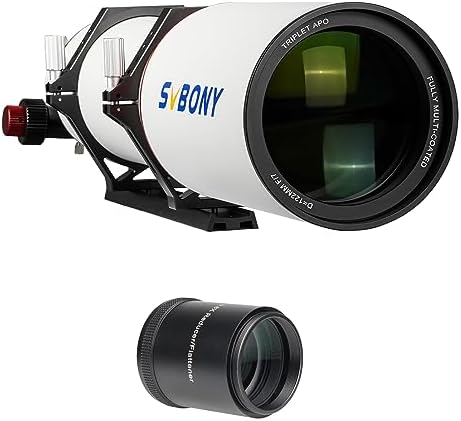
This premium kit includes both a focal reducer and field flattener for wide field imaging. The 122mm aperture gathers significant light for detailed deep sky photos.
We may earn a commission when you buy through this link, at no additional cost to you.
Using a FPL-51 triplet lens it enhances clarity and sharpness. The included SV209 flattener corrects edge curvature effectively for full frames.
While expensive, the bundle saves buying components separately. The focal reducer shortens exposure times for better efficiency.
Select this if you want a complete high-end imaging setup. It offers exceptional image quality for serious astrophotographers.
The SV209 flattener and reducer work together to correct curvature and widen the field.
The 122mm aperture provides a higher limiting magnitude for fainter objects.
We may earn a commission when you buy through this link, at no additional cost to you.
This comprehensive kit includes the OTA, flattener, and dovetail base. It is designed to be a complete solution for astrophotography enthusiasts.
We may earn a commission when you buy through this link, at no additional cost to you.
The 122mm aperture provides excellent detail and light grasp. Including the base makes carrying and moving the telescope straightforward.
While the price is high, you get essential accessories in one box. This reduces the hassle of matching compatible parts separately.
Choose this if you want a turn-key imaging solution. It simplifies the transition into serious astrophotography.
The SV209 flattener corrects field curvature to improve edge imaging quality.
A comfortable handle and dovetail base make the large OTA easy to move.
We may earn a commission when you buy through this link, at no additional cost to you.
This kit offers an 80mm triplet APO with a field flattener included. It is a great compact option for travel imaging with sharp results.
We may earn a commission when you buy through this link, at no additional cost to you.
The fully multilayer coated lenses prevent reflections and enhance contrast. A handle improves the safety factor during installation and transport.
While it is a simple setup, it is effective for many targets. The 80mm aperture balances light grasp with portability.
Pick this for a reliable compact imaging bundle. It is suitable for observers wanting a ready-to-use telescope.
Ultra wide band fully multilayer coated lenses bring bright and clear images.
A comfortable and convenient carrying handle is suitable for the SV550 series.
We may earn a commission when you buy through this link, at no additional cost to you.
This bundle includes a mini guide scope and a 1.23-megapixel camera for precise tracking. It is designed for users who need autoguiding for deep sky photography.
We may earn a commission when you buy through this link, at no additional cost to you.
The SV905C camera features low read noise for tight tracking of faint guide stars. The 122mm aperture ensures clear detailed images of deep sky objects.
While the camera is compact it is effective for guiding purposes. This saves the hassle of buying separate guiding equipment.
Choose this if you want an all-in-one guiding system. It streamlines your workflow for serious astrophotography.
The SV905C camera allows for tight tracking of faint guide stars with low read noise.
The 122mm aperture offers clear and detailed images suitable for deep sky photography.
We may earn a commission when you buy through this link, at no additional cost to you.
Selecting the right apochromatic refractor depends on your budget, observing goals, and technical needs. This guide breaks down the key factors to consider.
Aperture determines how much light the telescope gathers. Larger apertures reveal fainter deep sky objects but increase weight and cost.
For travel, 80mm is ideal. For serious imaging, 102mm to 122mm offers better light grasp.
Apochromatic lenses use special glass to eliminate color fringing. Triplet designs are generally better than doublets.
Look for ED glass like FPL51 or S-FPL51 for the best correction.
Focal ratio affects exposure time and field of view. Faster scopes like f/6 are better for wide deep sky objects.
Slower scopes like f/7 are better for planets and planetary nebulae.
A smooth focuser is critical for sharp images. Dual-speed focusers allow fine adjustments.
Ensure the focuser is sturdy enough to support your camera without sagging.
Consider the weight of the OTA and whether it comes with a case. Lighter scopes are easier to transport to dark sites.
Models with handles or dovetail bases improve ease of carrying.
Bundles often include field flatteners, reducers, or cameras. Check if these match your needs.
Buying a bare OTA allows more customization but costs more for accessories.
First, let your telescope equilibrate to outdoor temperatures to avoid thermal tube currents. This ensures the clearest views possible.
Use dew shields or heaters to prevent condensation on the objective lens during humid nights.
Store the telescope in a dry place and cover the lenses with caps to protect them from dust.
An apochromatic refractor uses special glass elements to eliminate color fringing. It produces sharp, true-color images unlike standard achromatic refractors.
Yes, they are excellent for beginners due to their ease of use and low maintenance. They require no complex adjustments or collimation.
Prices vary from $500 for small models to over $1500 for large imaging kits. Budget models often lack accessories included in premium bundles.
Yes, a stable mount is essential for both visual and imaging use. These telescopes are sold as Optical Tube Assemblies (OTAs) only.
A focal ratio of f/6 or f/7 is ideal for wide-field imaging. Faster scopes reduce exposure times significantly.
Absolutely. Apochromatic refractors deliver crisp views of planets, star clusters, and nebulae through eyepieces.
This guide reviewed ten top apochromatic refractors ranging from compact 71mm to larger 122mm models. The SVBONY SV550 80mm APO stands out as the top overall choice.
Prioritize optical quality and weight based on your transport needs. Bundles save money if you need specific accessories like flatteners.
Always check current prices and availability before purchasing as models update frequently.